AI, Neurons and Space

A useful way to understand what is changing in science right now is to stop watching model releases and start watching operational behavior. In space, operational behavior means you only win if you can predict, plan, and act under hard constraints, with limited bandwidth, limited power, and no ability to send a technician when something breaks. That environment is turning AI from a lab tool into something closer to a nervous system, coordinating perception, prediction, and decisions across missions and experiments.
Space weather is a good example because it is a physics driven problem with real downstream impact. Solar flares and coronal mass ejections can disrupt satellites, radio, navigation, and power systems, and the warning time is often the difference between mitigation and damage. A new AI tool described this week focuses on observing solar active regions to advance warnings of space weather events, which signals a broader trend toward AI systems that sit closer to physical precursors rather than only reacting to downstream measurements. https://phys.org/news/2026-02-ai-tool-solar-regions-advance.html
The same idea shows up in how we think about Earth as a system. Weather and climate forecasting is increasingly framed as a digital twin problem, where you want high resolution simulation, continuous data assimilation, and the ability to run massive ensembles to quantify uncertainty. Recent reporting on Europe’s Destination Earth effort highlights that this approach is not just about prettier maps, it is about decision grade forecasting for disasters, pollution, energy, and more. https://www.ft.com/content/da46666f-718f-49b5-8eca-11d3408b6f77
What is new in 2026 is that the AI side is now arriving as open models intended to run those ensembles cheaply and quickly. Reuters reported that Nvidia unveiled open AI models for faster and cheaper weather forecasts, framed around enabling extremely large ensemble forecasting that would be impractical with traditional simulation alone. Whether every claim holds up over time, the direction is clear: uncertainty quantification at scale is becoming an AI product feature, not an academic luxury. https://www.reuters.com/business/environment/nvidia-unveils-ai-models-faster-cheaper-weather-forecasts-2026-01-26/
In parallel, space operations themselves are becoming more autonomous. NASA reported that Perseverance completed its first AI planned drive on Mars, which is a small milestone with big implications. The more planning and navigation can be handled onboard, the more science can be done per day of mission time, and the less the mission cadence is limited by human planning cycles and communication delays. https://www.nasa.gov/missions/mars-2020-perseverance/perseverance-rover/nasas-perseverance-rover-completes-first-ai-planned-drive-on-mars/
Biology is part of this same shift, even though it looks different on the surface. The ISS National Lab recently described a record year for space based scientific results and pointed to biomedical themes like organoids and retinal disease research that are explicitly positioned as stepping stones toward clinical translation. What matters here is not microgravity as a curiosity. What matters is that space is being used as a controllable perturbation to stress biological systems in ways that can reveal mechanisms and drug responses faster than certain terrestrial setups. https://issnationallab.org/press-releases/iss-national-lab-marks-record-year-for-space-based-scientific-results/
Put together, the pattern is that AI is moving into the infrastructure layer of science. It is being used to anticipate solar activity, to scale probabilistic forecasting, to plan rover actions, and to help convert space biology into actionable biomedical pipelines. The interesting part is that these are not the easiest problems for AI. They are the ones where the world has hard rules and where failures are visible. That is why this trend is worth watching. As AI gets embedded into scientific operations, progress will increasingly be measured in throughput, warning time, and validated outcomes, not in demos.
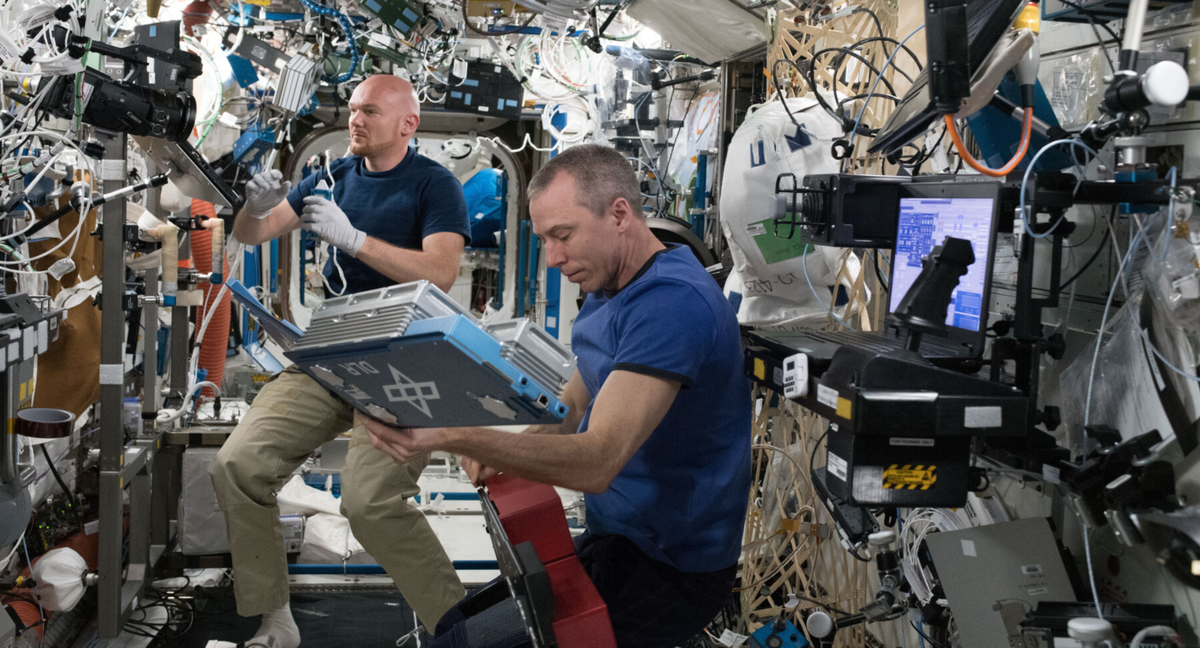
Image source for the header: European Space Agency, FLUMIAS experiment on the International Space Station. https://www.esa.int/ESA_Multimedia/Images/2018/10/FLUMIAS_experiment_on_the_International_Space_Station