Looking smart, without being smart, the AI way

Why the Most Dangerous Medical AI Failure Is Looking Smart for the Wrong Reason
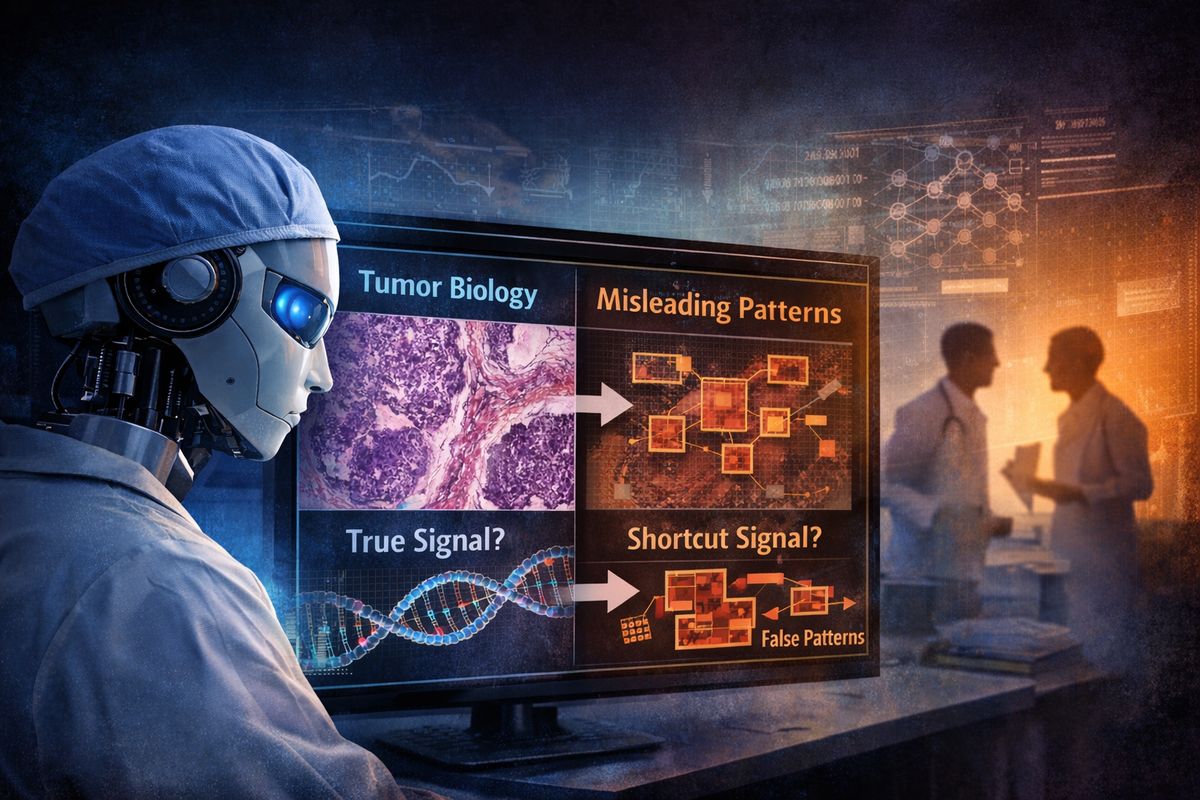
One of the most important medicine and AI stories from the past two weeks is not about a model that performed brilliantly. It is about a model that may have looked brilliant for the wrong reason. Researchers at the University of Warwick reported on March 2, 2026 that some AI systems designed for cancer pathology appear to rely on “shortcut learning” rather than genuine biological signals when predicting biomarkers from tissue images. In plain language, that means a model can seem highly accurate while actually keying off misleading visual patterns that happen to correlate with the answer, instead of reading the underlying disease biology. (University of Warwick)
That matters because digital pathology is one of the most promising areas in medical AI. The idea is deeply attractive. A scanned biopsy slide could be analyzed by a model to infer molecular features of a tumor, potentially reducing the need for slower or more expensive lab tests. If that worked reliably, it could speed diagnosis, guide treatment, and make advanced cancer care more accessible. But the Warwick team’s warning cuts to the center of that promise. A system that learns shortcuts may perform well on familiar datasets and still fail when it meets new hospitals, new scanners, new staining practices, or new patient populations. (University of Warwick)
This is not a niche technical concern. It is one of the core dangers of AI in medicine. When people hear that a model can detect cancer features from an image, they often imagine that it has learned something almost pathologist like, some meaningful visual representation of the biology inside the tissue. Shortcut learning means that assumption may be false. The model may instead be exploiting subtle artifacts, site specific cues, or hidden correlations that have little to do with the disease process itself. A broader 2024 study in npj Digital Medicine found that shortcut learning can substantially inflate performance estimates in medical AI, showing that this is not a one off pathology problem but a recurring weakness in clinical machine learning. (Nature)
There is something especially unsettling about this in cancer care. Oncology already depends on high stakes classification. Small errors can change which drug a patient receives, whether further testing is ordered, or how aggressive treatment becomes. If an AI tool predicts a biomarker because it has learned a visual shortcut instead of true tumor biology, then the risk is not just academic embarrassment. The risk is misplaced confidence. A wrong answer delivered with statistical polish can be more dangerous than obvious uncertainty, because it invites clinicians and health systems to trust something that has not actually understood the task. (The ASCO Post)
This story also says something larger about the current phase of AI in medicine. For the last few years, the field has been full of benchmark wins, headline accuracy numbers, and claims that models can infer increasingly complex biological information directly from images. Some of those advances are real. But medicine is now entering a more mature stage, one in which the key question is no longer just whether an AI system can produce the right answer on a test set. The harder question is why it arrived at that answer, and whether the reasoning would still hold outside the narrow conditions in which it was trained. The Warwick findings are a reminder that performance without robustness is not readiness. (University of Warwick)
There is an irony here that makes the issue even more important. AI is often promoted as a way to uncover hidden biology that humans might miss. But if the model is learning shortcuts, then it may be doing the opposite. It may be obscuring biology behind a layer of false pattern recognition. That is why this kind of research is so valuable. It does not just criticize existing tools. It forces the field to become more scientifically honest. A useful medical AI system should not merely be predictive. It should be generalizable, interpretable enough to audit, and stress tested across the messy variation of real clinical environments. (University of Warwick)
For readers outside the AI world, the lesson is simple. In medicine, getting the right answer is not always enough. You also need confidence that the answer came from the right signal. A student who guesses correctly has not mastered the subject. A medical AI that guesses correctly for the wrong reason has not mastered the disease. That distinction may sound philosophical, but it is becoming one of the most practical questions in digital health. (Nature)
This is why the story deserves attention. It is not a tale of failure in the dramatic sense. It is something more useful than that. It is an early warning. As AI moves deeper into pathology, radiology, and clinical decision making, the greatest danger may not be that the systems look obviously incompetent. It may be that they look impressively competent while quietly depending on patterns that medicine cannot trust. And in a field where trust is built on evidence, that is exactly the kind of illusion researchers need to break before patients pay the price. (University of Warwick)
Sources
University of Warwick press release, “AI cancer tools risk ‘shortcut learning’ rather than detecting true biology.” (University of Warwick)
Medical Xpress coverage, “AI cancer tools may rely on 'shortcut learning' rather than genuine biology.” (Medical Xpress)
The ASCO Post coverage, “Research Suggests AI Pathology Models May Take Unreliable 'Shortcuts' to Identify Cancer Biomarkers.” (The ASCO Post)
npj Digital Medicine, “Shortcut learning in medical AI hinders generalization.” (Nature)