Why the Best Medical AI May Be the One That Argues With the Doctor

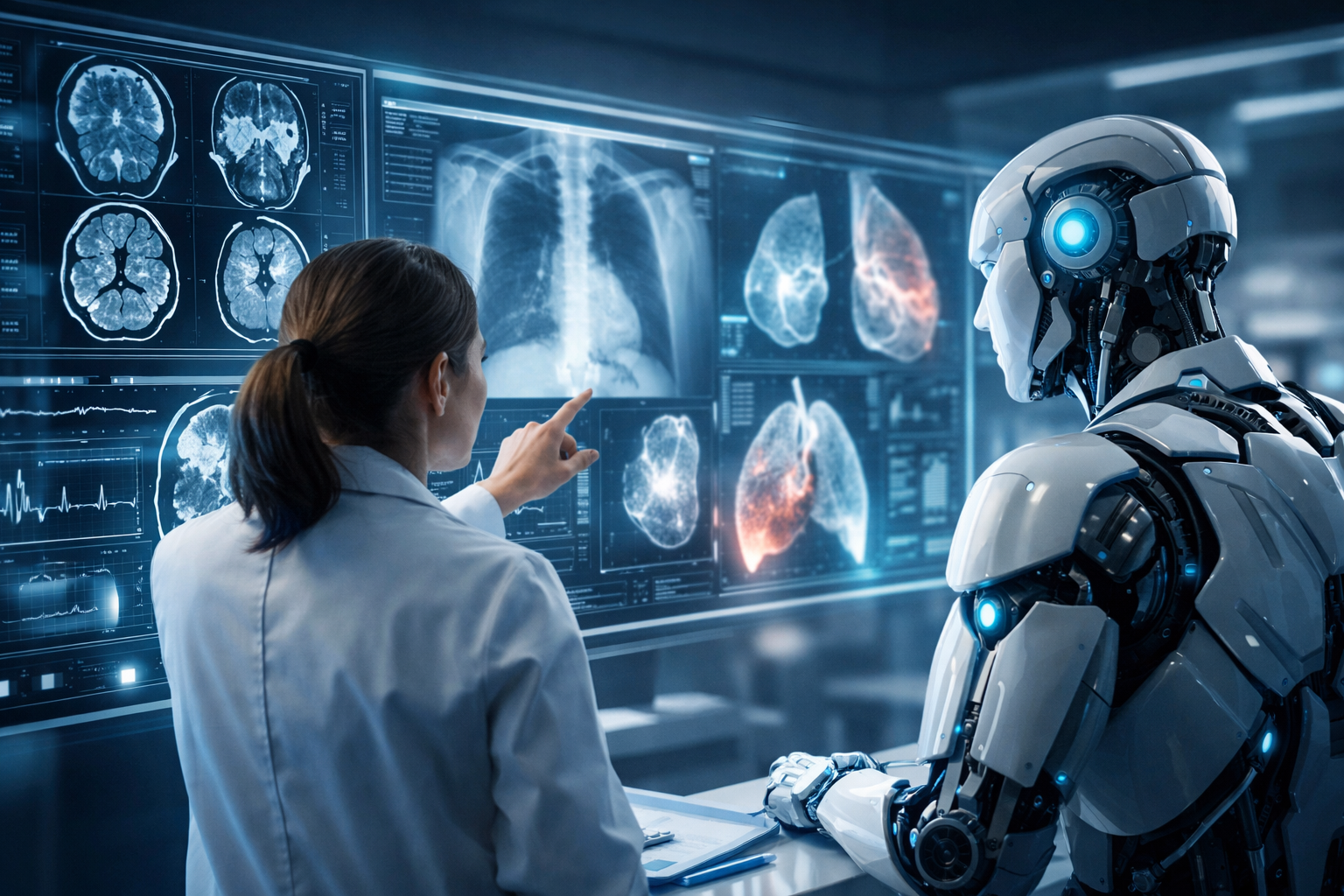
One of the most technically interesting AI and medicine stories of the last few days is not about a model outperforming clinicians in isolation. It is about workflow. A randomized controlled trial published in npj Digital Medicine tested what happens when clinicians and an LLM do not simply exchange prompts, but work through a structured collaborative diagnostic process. The study enrolled 70 clinicians and compared conventional resources with two clinician AI workflows: AI first, where the model gives an independent assessment before the clinician, and AI second, where the clinician reasons first and the model responds afterward. Both collaborative workflows improved clinician diagnostic accuracy over conventional resources, reaching 85 percent and 82 percent versus 75 percent, while AI alone scored 90 percent.
That result matters for a deeper reason than the headline numbers. Medical AI has often been framed as either a tool or a rival. Either it helps with paperwork and summarization, or it competes with physicians on benchmark questions. This trial points toward something more interesting. The value may come from structured disagreement. The system used in the study did not just spit out an answer. It generated an independent assessment, then produced a synthesis that highlighted agreements, disagreements, and commentary across the two lines of reasoning. In other words, the model was not only predicting. It was participating in diagnostic friction.
That is a much more serious design choice than it first appears. Diagnosis is rarely a single shot classification problem. It is a reasoning process shaped by anchoring bias, premature closure, incomplete data, and the human tendency to settle too quickly on a plausible story. A workflow that forces two different reasoners to arrive independently and then compare notes can make those failures more visible. The technical significance of the paper is not merely that AI helped accuracy. It is that the architecture of collaboration was treated as an object of study.
This also explains why the trial is more interesting than the usual leaderboard story. If AI alone scored 90 percent and the collaborative workflows scored slightly lower, the naive interpretation would be that humans are still dragging the model down. But that misses the point. Medicine does not need a sterile winner in a benchmark contest. It needs systems that can survive contact with real clinicians, real accountability, and real uncertainty. A model that is highly accurate but poorly integrated into clinical thinking is not yet a medical system. It is just a smart component. The paper explicitly frames the question as shifting from whether AI can offer useful suggestions to how it integrates into physicians’ diagnostic workflows.
There is also a broader lesson here for AI in biology and medicine. We are leaving the era where raw model capability is the only exciting variable. Workflow design is becoming first class. That means order matters. Timing matters. Independence of reasoning matters. The difference between AI as first opinion and AI as second opinion is not just cosmetic. It changes who gets anchored first, how disagreement is interpreted, and whether the model is acting more like a primer or a challenger. The study found both collaborative workflows improved clinician performance, and that the difference between them was not statistically significant, which suggests the main gain may come from the existence of structured collaboration itself rather than a single privileged sequence.
For technical readers, this looks like the same transition happening elsewhere in AI. In coding, the conversation is moving from autocomplete toward repository level planning and tool use. In medicine, it is moving from static answers toward multi step interaction designs that shape reasoning over time. The important unit is no longer just the model. It is the human model system. And in that system, a good interface may be as important as a good benchmark.
The caution, of course, is that diagnosis in a trial is not diagnosis in a hospital ward at scale. The paper itself notes that early studies have largely treated AI as a tool rather than an active collaborator, and this trial is part of the effort to test more realistic forms of collaboration. That means we are still early. But early is not the same as trivial. Randomized evidence on clinician AI collaboration is exactly the kind of work the field needs if it wants to move beyond hype and into system design.
That is why this story matters. The future of medical AI may not belong to the system that talks the most confidently or scores highest when left alone. It may belong to the system that knows how to disagree productively, surface uncertainty, and force better reasoning before a diagnosis hardens into a decision.